
“Which source do I trust?”
The carrier's live record says one thing, the spreadsheet from 2022 says another. You want to be told there's a conflict and which one is current — not handed a confident blend of the two.
Your AI can't tell you. It wasn't there last March, and the chat that was is gone. VaultHelm keeps the job instead of the conversation: every session filed under the customer it was for, every answer showing the record it came from, and anything that would change something real stopped until you say so.
Select beta — opening shortly
These are the questions that actually come up on a Tuesday. Put any of them to the assistant you use today and watch what happens.
The carrier's live record says one thing, the spreadsheet from 2022 says another. You want to be told there's a conflict and which one is current — not handed a confident blend of the two.
Something broke in June and a few things were left hanging. You want the list, checked against everything filed since — including the items where the answer is that nobody ever went back.
Not the drawing from three years ago. What's true now, and how old that answer is, so you don't spend the morning fixing the wrong layer.
Silence has to be visible. The most expensive answer isn't a wrong one, it's a comfortable one — a follow-up nobody did, reported as if it happened. A backup that stopped running. Footage that archived nothing for months while every status screen read healthy. We build on the assumption that our own parts will fail while insisting they're fine, so when something here can't do its job it says so, in the moment, instead of handing you a confident answer built on a dead source.

If you use AI for a couple of hours a week, you don't need this — there isn't enough being lost to be worth the setup. If the firm's memory is one person's chat history across twenty customers, you do.
Dozens of customers, one head. Work gets filed under the right customer by itself, and years later you can show them exactly what you did and when.
Where all the important knowledge lives in one person. When that person is on holiday — or leaves — the record still makes sense to whoever opens it.
Regulated work, client billing, anything where “the AI did it” won't fly. Every action traces to a suggestion, a person who approved it, and a time.
“Your AI suggests. You decide. The record keeps.”
That's the entire product, in a few words
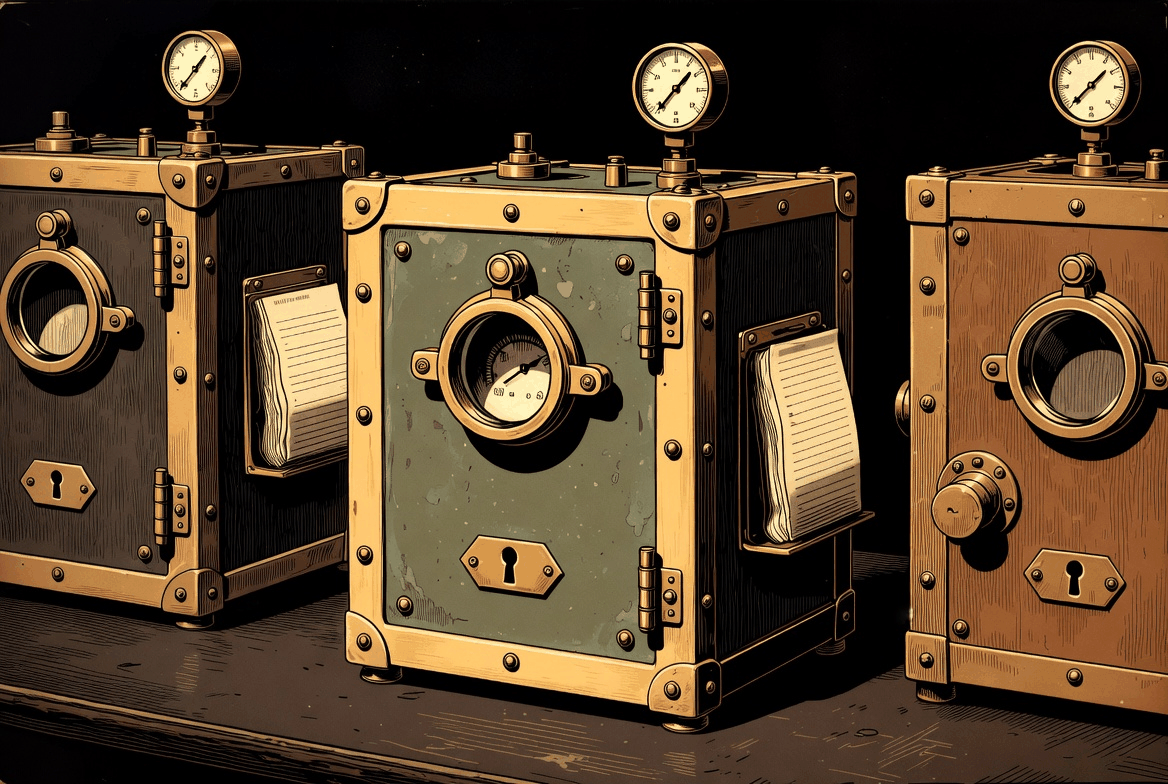
The name is the whole product. One half keeps what happened. The other half decides what's allowed to happen next.
When you finish working, you say one word. Everything from that session gets written down, split up by who it was for, and filed — automatically. Work three customers in one afternoon and it becomes three separate histories, each one filed under the right name, without you sorting anything.
Then it tells you what it did with it. Not “saved” — what was kept, where each piece went, and how much of the session it accounted for.
Months later you ask “what did we actually do the last time this broke?” and you get the answer, plus the original conversation it came from, word for word. Say the word twice by accident and nothing duplicates.
It's all saved as ordinary text files — you could read any of them in Notepad — in a copy that belongs to you and nobody else. We run it for you today, and you can take the whole folder, history and all, whenever you want it.
We don't ask the AI to behave. Nobody instructs it to be careful and hopes. The refusal happens on the server, outside the conversation entirely — so you could talk it into agreeing to anything you like and it still can't do it, because what it would need isn't there.
It can read what you've given it and draft anything you want. When it wants to do something that actually matters, that request lands in front of you with what it wants to do and why.
You say yes, no, later, or hand it to someone else — whenever you get to it. A request sitting unanswered for a week isn't a problem. That's the point.
Four things, and we would rather name them than let you guess. A folder of plain text files that is yours — that is the record itself, not a database and not a format belonging to somebody else. A connection your AI plugs into, which hands it who you are and what the rules are the moment it wakes up. Search, so you can find any of it by customer, project, date or word. And one word at the end of a session that files the whole thing away.
That is the product. Everything further down this page is built on those four, and there is nothing else you have to buy to get the part that matters.
Open the folder on your own machine and there it is — the customer, the date, the write-up, the original conversation underneath it. No app, no login, no export. Ordinary text files you could read in Notepad. That is not a backup of the product. That is the product.
Which is why the assistant is the swappable part. Right now every one of them keeps its own memory and none of them share, so what you told one is invisible to the next. Here they all read the same record instead. Ask any of them what happened on Tuesday and you get the same answer, because there is only one answer to get.
To be exact about what does and does not move: nothing is piped between AI companies. Your conversation with one is never handed to another. What carries over is the written record on your side — and only what you chose to file into it.
This isn't switching between them. Have three open together, working the same job from different angles — one drafting, one checking the other's answer, one on your phone in the van. They all read the same record, so none of them begins from nothing and none of them needs briefing.
It is not only the record that is shared. A request raised by one AI can be approved from a completely different one — proposed at your desk in the morning, approved from your phone that evening, in another app entirely.
When something better launches, you just try it. Everything you have built up carries straight over, because it was never stored inside the AI in the first place. The same goes when an AI company changes how its assistant connects to outside tools — that is our wiring to redo, not your record to rebuild. New assistants connect to the record you already have.
They don't see each other's work the instant it lands. There is a short catch-up between one filing something and the next one being able to read it. For nearly everybody that is invisible — you are not usually asking two assistants about the same sentence in the same minute.
If you want that gap closer to nothing, it can be tuned, and it costs more to run. That is a real trade and we'd rather price it honestly than pretend the delay isn't there. We'll tell you what the gap is on your setup before you're asked to care about it.
Reading at the same time is free and unlimited. Writing is the part that's deliberately arranged so two assistants can't quietly overwrite each other's work — you never have to coordinate them, and you never find out later that one of them stamped on the other.
If we disappeared tomorrow you would still have the folder, with its full history, opening on any computer you own. A record you can't read without the company that sold it to you was never really your record — and a company that stores it any other way has a reason for that, whether or not they'll tell you what it is.
The overhead paging is dead at a customer's site. The same question went to the same assistant twice — once as it comes out of the box, once with the vault connected. Nothing changed but the record it was allowed to read.
“If the PA wasn’t working at [our yard] — how would you suggest I troubleshoot?”
Every session above ran on Grok. The June repair notes it was reading had been filed months earlier by a different assistant entirely. Neither one knew the other existed, and neither had to — they were both just reading the same record. Change assistants next year and the record doesn’t move.
Worth saying out loud, because you'd work it out during the walkthrough anyway. Ours also keeps a calendar, tracks jobs through to done, and watches equipment across the sites we look after. None of that is in what you'd be buying today. Those are being packaged to snap on afterwards, one at a time, and we'll say when each one is ready.
What ships now is the part everything else needs: the record, the connection, the search, and the word that files it. We'd rather sell you a small thing that works than a long list you have to take on faith — and we'd rather you heard the difference from us than found it in month three.
It also means the thing you're being shown isn't a demo environment. It's the system this business is actually run on, with the day's real mess in it. If something is slow or awkward on the call, you'll see that too.
Half an hour, no slides. We'll show you a real session get saved, then found again weeks later, then traced back to the original conversation. Then you can decide.
A select beta opens shortly. A small number of shops, taken on one at a time, because each one gets set up by hand and we would rather do that properly than at volume. No price list yet — we are not going to publish a number before we have watched it work in somebody else's business. Ask now and you are in the conversation for a place.